


Treating Skin Conditions with Chinese Medicine

Skin conditions can be incredibly frustrating to deal with. Many people I work with have tried multiple treatments, often cycling through creams, medications, or restrictive diets, only to have symptoms come back or never fully resolve.
The way I approach dermatology is a bit different. Instead of focusing only on what is happening on the surface of the skin, I look at what is happening inside the body that is leading the skin to present this way.
The Skin Reflects Internal Health
In Chinese medicine, the skin is closely connected to internal systems like digestion, circulation, and the nervous system. When something is out of balance internally, the skin often becomes a place where that imbalance shows up.
Rather than treating everyone with the same diagnosis the same way, I look at patterns in the body. These patterns help explain why two people with eczema or acne can look very different and respond to completely different treatments.
You’ll often hear terms like heat, dampness, dryness, or wind in Chinese medicine. These are simply ways of describing how symptoms behave in the body.
Heat refers to inflammation. This can look like redness, swelling, irritation, or a burning sensation in the skin.
Dampness refers to fluid accumulation or sluggish processing in the body. On the skin, this can show up as oozing, weeping, cystic breakouts, or a heavier, more congested presentation.
Dryness looks like flaking, cracking, or rough skin that lacks moisture.
Wind is used to describe movement and unpredictability. It often shows up as itching, symptoms that come and go, or rashes that spread or change quickly.
These patterns give us a framework to understand what the body is doing and guide how we treat it.
How I Treat Skin Conditions
I use a combination of herbal medicine and acupuncture to address both the underlying imbalance and the visible symptoms.
Herbal Medicine
Herbal medicine is usually the primary tool I use for dermatology.
Formulas are customized for each person and adjusted over time. The goal is not just to suppress symptoms, but to shift the internal environment so the skin no longer needs to express the issue.
Depending on the presentation, herbs may be used to reduce inflammation, support digestion, improve circulation, and calm immune overactivity.
If someone has very red, inflamed skin, the focus is often on cooling and calming. If the skin is more dry and depleted, the focus shifts toward nourishing and rebuilding.
This is why formulas evolve throughout treatment. The body changes, and the treatment should change with it.
Acupuncture
Acupuncture supports the process by helping regulate the systems that influence the skin.
It can help reduce inflammation, improve circulation, support digestion, and regulate the nervous system. Stress plays a major role in many skin conditions, and acupuncture is often one of the most effective tools for helping the body come out of that reactive state.
Treating What You See and What You Don’t
A big part of this work is treating both the visible symptoms and the underlying cause.
The redness, itching, breakouts, or dryness all need to be addressed so the person feels better. At the same time, if the internal imbalance is not treated, the condition tends to come back.
So the treatment is always happening on both levels at once.
A Clinical Example
One of the most common patterns I see in eczema is that it changes over time, and treatment has to follow that progression.
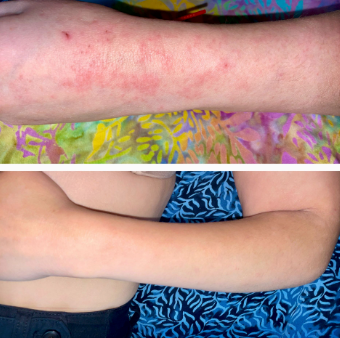
In one case, a patient came in with chronic eczema that initially presented as what we would describe as damp heat. The skin was inflamed, red, and slightly weeping in certain areas, with a feeling of irritation and congestion.
We started treatment by focusing on clearing that inflammatory, damp pattern.
As the skin began to calm, the presentation shifted. The redness remained but became more dry and less exudative. At that point, the focus of treatment changed to cooling what we call heat in the blood, which is a deeper level of inflammation that tends to drive persistent redness and flare-ups.
Once that layer resolved, the final phase of treatment focused on strengthening digestion. In Chinese medicine, the digestive system plays a central role in how fluids and inflammation are processed in the body. If it is not functioning well, skin conditions are much more likely to return.
Over the course of about five months, the skin cleared significantly and stabilized.
Here are before and after images from that process:

Research and Clinical Evidence
There is also a growing body of research supporting the use of Chinese herbal medicine for dermatological conditions like eczema, psoriasis, acne, and chronic hives.
In eczema, multiple systematic reviews have shown that herbal medicine can reduce itching, inflammation, and overall severity of symptoms (Gu et al.). Some studies also suggest that patients are able to reduce their reliance on topical steroids over time when herbal treatment is used consistently.
In psoriasis, research has shown improvements in disease severity scores, especially when herbal medicine is used alongside conventional care (Zhang et al.). Many of the herbs studied have measurable anti-inflammatory and immune-regulating effects, which aligns with how we understand these conditions clinically.
Studies on acne have found that herbal medicine can perform similarly to antibiotics in some cases, without the same long-term impact on the gut or microbiome (Cao et al.).
There is also evidence that herbal medicine can help regulate immune responses in conditions like chronic hives, improving symptom control and reducing recurrence (Li).
While research is still evolving, it continues to support what we see clinically. When the internal environment shifts, the skin often follows.
Why It Takes Time
Skin conditions usually do not develop overnight, and they rarely resolve overnight either.
As the internal environment changes, the skin follows. Most people start to notice some shifts within a few weeks, but more lasting changes take time and consistency.
An Integrative Approach
I often work alongside Western treatments when it makes sense. This does not have to be an either-or situation.
Chinese medicine can help improve overall outcomes by supporting inflammation, digestion, and nervous system regulation. Over time, many people find they are able to rely less on medications or experience more stability.
Listening to the Skin
One of the most important shifts is seeing the skin not as something to fight against, but as something that is communicating.
When you understand the patterns behind it, the condition starts to make sense. And when treatment is aligned with those patterns, healing becomes more sustainable.

Dr. Alexis Fernandez is a Doctor of Chinese Medicine, licensed acupuncturist, and board-certified herbalist who focuses on treating inflammatory skin conditions such as eczema, rosacea, acne, psoriasis, and seborrheic dermatitis.
If you’re looking for a more personalized, root-cause approach to treating chronic skin conditions, schedule a consultation with Dr. Fernandez today.

Comments